
You are viewing an archive of Victory Road.
Victory Road closed on January 8, 2018. Thank you for making us a part of your lives since 2006! Please read this thread for details if you missed it.

Haxorus
343 posts
I'm not sure if you guys are interested in taking this test. But, it's a good idea to know what it is you're going though.
http://www.4degreez.com/misc/persona...sorder_test.mv
If you like to show off your results you can as well.
Here's mine:
http://postimage.org/image/hijr0gjo/

Giratina
3,238 posts
I was low on everything but Obsessive-Compulsive. Makes sense.
Shaymin
2,854 posts
:I
Disorder | Rating
Paranoid: Low
Schizoid: Low
Schizotypal: Moderate
Antisocial: Low
Borderline: Low
Histrionic: Moderate
Narcissistic: Moderate
Avoidant: Low
Dependent: High
Obsessive-Compulsive: High
Why
 1 – LucarioQueen
Haxorus
369 posts
Disorder | Rating
Paranoid: Low
Schizoid: Low
Schizotypal: Moderate
Antisocial: Low
Borderline: Low
Histrionic: Low
Narcissistic: Low
Avoidant: Low
Dependent: Moderate
Obsessive-Compulsive: Moderate

Volcarona
491 posts
Paranoid: High
Schizoid: Moderate
Schizotypal: Very High
Antisocial: Moderate
Borderline: Very High
Histrionic: High
Narcissistic: High
Avoidant: High
Dependent: High
Obsessive-Compulsive: High (red)
>_>
"Mom!"

Moderator
2,066 posts
These are actually my results on the same test from a year ago, but I don't think I've changed much since.
Paranoid: Low
Schizoid: Low
Schizotypal: Low
Antisocial: Low
Borderline: Low
Histrionic: Low
Narcissistic: Moderate
Avoidant: Low
Dependent: Low
Obsessive-Compulsive: Low
2 – LiteTheIronMan, Leaftail
Shaymin
2,854 posts
|
Originally Posted by PokeRemixStudio

These are actually my results on the same test from a year ago, but I don't think I've changed much since.
Paranoid: Low Schizoid: Low Schizotypal: Low Antisocial: Low Borderline: Low Histrionic: Low Narcissistic: Moderate Avoidant: Low Dependent: Low Obsessive-Compulsive: Low |
 1 – PokeRemixStudio
Volcarona
565 posts
Paranoid: High
Schizoid: Moderate
Schizotypal: Moderate
Antisocial: High
Borderline: Moderate
Histrionic: Moderate
Narcissistic: High
Avoidant: High
Dependent: Moderate
Obsessive-Compulsive: Low

Charizard
108 posts
Paranoid: High
Schizoid: Moderate
Schizotypal: High
Antisocial: High
Borderline: Very High
Histrionic: High
Narcissistic: High
Avoidant: Very High
Dependent: High
Obsessive-Compulsive: High
1 – Armed Floatzel
Giratina
3,415 posts
Paranoid: Moderate
Schizoid: Very High
Schizotypal: Moderate
Antisocial: High
Borderline: Low
Histrionic: Low
Narcissistic: Moderate
Avoidant: Low
Dependent: Low
Obsessive-Compulsive: Low
So apparently I'm as antisocial as ****.
Never would've guessed that.
1 – zsaberslash
Zoroark
205 posts
Paranoid: Moderate
Schizoid: Moderate
Schizotypal: High
Antisocial: High
Borderline: Very High
Histrionic: High
Narcissistic: High
Avoidant: High
Dependent: Moderate
Obsessive-Compulsive: Low

Haxorus
452 posts
Paranoid: Low
Schizoid: Low
Schizotypal: Low
Antisocial: Low
Borderline: Low
Histrionic: Low
Narcissistic: Low
Avoidant: Low
Dependent: Low
Obsessive-Compulsive: High

Giratina
3,185 posts
I realized this was complate crap (Before I thought it was 95% crap) the second it mentioned ESP
Here's my results anyways (a la table)
| Paranoid: | Low |
| Schizoid: | Low |
| Schizotypal: | Moderate |
| Antisocial: | High |
| Borderline: | Low |
| Histrionic: | Low |
| Narcissistic: | Moderate |
| Avoidant: | High |
| Dependent: | Low |
| Obsessive-Compulsive: | High |
1 – Firo
Rayquaza
4,872 posts
Now look at mine
Disorder | Rating
Paranoid: Low
Schizoid: Low
Schizotypal: Moderate
Antisocial: Moderate
Borderline: Low
Histrionic: High
Narcissistic: Moderate
Avoidant: Moderate
Dependent: Low
Obsessive-Compulsive: Moderate

Haxorus
360 posts
Disorder | Rating
Paranoid: Low
Schizoid: Low
Schizotypal: Low
Antisocial: Low
Borderline: Low
Histrionic: Moderate
Narcissistic: Moderate
Avoidant: Low
Dependent: Low
Obsessive-Compulsive: Low
I'm not sure what to say about this. Mainly because I can't think of anything witty to say. But I'm pretty good when it comes to my mental health.

Volcarona
547 posts
Disorder | Rating
Paranoid: Low
Schizoid: Moderate
Schizotypal: Moderate
Antisocial: Low
Borderline: Low
Histrionic: Low
Narcissistic: Low
Avoidant: Low
Dependent: Low
Obsessive-Compulsive: Low
Shaymin
2,854 posts
Still can't help but point out that although I'm accused of being narcissistic a lot of people ranked higher on that category than me
Haxorus
343 posts
I feel embarrassed because my scores are higher than everyone else.

Landorus
1,770 posts
Everything I have is low to moderate except for schizoid, which looks to me like an entirely different personality than what I actually have.
And lite, you may not be more narcissistic than others, but you're way more openly egotistical.
5 – Jaredvcxz, SK, Shiny, A'bom, Firo
Shaymin
2,679 posts
Paranoid: Low
Schizoid: Low
Schizotypal: Moderate
Antisocial: Low
Borderline: Low
Histrionic: High (Uhm. <_< >_>)
Narcissistic: Low
Avoidant: Low
Dependent: Moderate
Obsessive-Compulsive: High
Not exactly surprised but. >w>

Volcarona
653 posts
Paranoid: Low
Schizoid: Low
Schizotypal: Low
Antisocial: Low
Borderline: Low
Histrionic: Low
Narcissistic: Low
Avoidant: Low
Dependent: Low
Obsessive-Compulsive: Low
If I continue to have depression throughout middle school and into high school, I would score higher on Schizoid and Schizotypal. I used to think that I have the ability to predict the future and have a deja vu in a place even though I never been there before.

Kyurem
2,485 posts
Paranoid: Moderate
Schizoid: Low
Schizotypal: High
Antisocial: Low
Borderline: Low
Histrionic: High
Narcissistic: High
Avoidant: Moderate
Dependent: Moderate
Obsessive-Compulsive: High
I have no idea wtf half of these words mean. -.-
2 – Shadow, Firo
Giratina
3,185 posts
|
Originally Posted by Kirby-Chan
Paranoid: Low
Schizoid: Low Schizotypal: Low Antisocial: Low Borderline: Low Histrionic: Low Narcissistic: Low Avoidant: Low Dependent: Low Obsessive-Compulsive: Low If I continue to have depression throughout middle school and into high school, I would score higher on Schizoid and Schizotypal. I used to think that I have the ability to predict the future and have a deja vu in a place even though I never been there before. |
8 – Ningamer, Kirby-Chan, Kaorto, Shiny, SK, Leaftail, Shadow, Firo
Shaymin
2,854 posts
|
Originally Posted by Shiny
Paranoid: Moderate
Schizoid: Low Schizotypal: High Antisocial: Low Borderline: Low Histrionic: High Narcissistic: High Avoidant: Moderate Dependent: Moderate Obsessive-Compulsive: High I have no idea wtf half of these words mean. -.- |
Paranoia is a thought process believed to be heavily influenced by anxiety or fear, often to the point of irrationality and delusion. Paranoid thinking typically includes persecutory beliefs concerning a perceived threat towards oneself. Historically, this characterization was used to describe any delusional state.
Schizoid personality disorder (SPD) is a personality disorder characterized by a lack of interest in social relationships, a tendency towards a solitary lifestyle, secretiveness, emotional coldness and sometimes (sexual) apathy, with a simultaneous rich, elaborate and exclusively internal fantasy world.[1] SPD is not the same as schizophrenia, although they share some similar characteristics such as detachment or blunted affect; there is increased prevalence of the disorder in families with schizophrenia.[2]
The bit about schizophrenia is a bit longSchizophrenia ( /ˌskɪtsɵˈfrɛniə/ or /ˌskɪtsɵˈfriːniə/) is a mental disorder characterized by a disintegration of thought processes and of emotional responsiveness.[1] It most commonly manifests as auditory hallucinations, paranoid or bizarre delusions, or disorganized speech and thinking, and it is accompanied by significant social or occupational dysfunction. The onset of symptoms typically occurs in young adulthood, with a global lifetime prevalence of about 0.30.7%.[2] Diagnosis is based on observed behavior and the patient's reported experiences.
Genetics, early environment, neurobiology, and psychological and social processes appear to be important contributory factors; some recreational and prescription drugs appear to cause or worsen symptoms. Current research is focused on the role of neurobiology, although no single isolated organic cause has been found. The many possible combinations of symptoms have triggered debate about whether the diagnosis represents a single disorder or a number of discrete syndromes. Despite the etymology of the term from the Greek roots skhizein (σχίζειν, "to split") and phrēn, phren- (φρήν, φρεν-; "mind"), schizophrenia does not imply a "split mind" and it is not the same as dissociative identity disorderalso known as "multiple personality disorder" or "split personality"a condition with which it is often confused in public perception.[3]
The mainstay of treatment is antipsychotic medication, which primarily suppresses dopamine, and sometimes serotonin, receptor activity. Psychotherapy and vocational and social rehabilitation are also important in treatment. In more serious caseswhere there is risk to self and othersinvoluntary hospitalization may be necessary, although hospital stays are now shorter and less frequent than they were.[4]
The disorder is thought mainly to affect cognition, but it also usually contributes to chronic problems with behavior and emotion. People with schizophrenia are likely to have additional (comorbid) conditions, including major depression and anxiety disorders; the lifetime occurrence of substance abuse is almost 50%.[5] Social problems, such as long-term unemployment, poverty and homelessness, are common. The average life expectancy of people with the disorder is 12 to 15 years less than those without, the result of increased physical health problems and a higher suicide rate (about 5%).[2]
Antisocial personality disorder (ASPD) is defined by the American Psychiatric Association's Axis II (personality disorders) of the Diagnostic and Statistical Manual (DSM-IV-TR) as "...a pervasive pattern of disregard for, and violation of, the rights of others that begins in childhood or early adolescence and continues into adulthood."[1]
Antisocial personality disorder is sometimes referred to as psychopathy or sociopathy; however, many scholars make distinctions among these terms, though there remains no academic consensus as to their definitions. Currently, for this reason, neither psychopathy nor sociopathy are valid diagnoses described in the Diagnostic and Statistical Manual of Mental Disorders,[2] and the ICD-10 of the World Health Organization also lacks psychopathy as a diagnostic disorder.[3] Psychopathy is normally seen as a subset of the antisocial personality disorder, but Blair believes that the antisocial personality disorder and psychopathy may be separate conditions altogether.[4] Many people with this disorder are not violent.
Borderline personality disorder (BPD) is a personality disorder described as a prolonged disturbance of personality function in a person (generally over the age of eighteen years, although it is also found in adolescents), characterized by depth and variability of moods.[n 1] The disorder typically involves unusual levels of instability in mood; black and white thinking, or splitting; the disorder often manifests itself in idealization and devaluation episodes, as well as chaotic and unstable interpersonal relationships, self-image, identity, and behavior; as well as a disturbance in the individual's sense of self. In extreme cases, this disturbance in the sense of self can lead to periods of dissociation.[1]
BPD splitting includes a switch between idealizing and demonizing others. This, combined with mood disturbances, can undermine relationships with family, friends, and co-workers. BPD disturbances also may include self-harm.[2] Without treatment, symptoms may worsen, leading (in extreme cases) to suicide attempts.[n 2]
There is an ongoing debate among clinicians and patients worldwide about terminology and the use of the word borderline,[3] and some have suggested that this disorder should be renamed.[4] The ICD-10 manual has an alternative definition and terminology to this disorder, called Emotionally unstable personality disorder. There is related concern that the diagnosis of BPD stigmatizes people and supports pejorative and discriminatory practices.[5]
Histrionic personality disorder (HPD) is defined by the American Psychiatric Association as a personality disorder characterized by a pattern of excessive emotionality and attention-seeking, including an excessive need for approval and inappropriately seductive behavior, usually beginning in early adulthood. These individuals are lively, dramatic, vivacious, enthusiastic, and flirtatious.
They may be inappropriately sexually provocative, express strong emotions with an impressionistic style, and be easily influenced by others. Associated features may include egocentrism, self-indulgence, continuous longing for appreciation, and persistent manipulative behavior to achieve their own needs.
Narcissism is also a bit tl;drNarcissism is a term with a wide range of meanings, depending on whether it's being used to describe a central concept of psychoanalytic theory, a mental illness, a social or cultural problem, or simply an undesirable personality trait. Except in the sense of primary narcissism or healthy self-love, "narcissism" usually is used to describe some kind of problem in a person or group's relationships with self and others. In everyday speech, "narcissism" often means inflated self-importance, egotism, vanity, conceit, or simple selfishness. Applied to a social group, it is sometimes used to denote elitism or an indifference to the plight of others. In psychology, the term is used to describe both normal self-love and unhealthy self-absorption due to a disturbance in the sense of self.
The term "narcissism" was introduced in 1887 by Alfred Binet but its usage today stems from Freud's 1914 essay, On Narcissism. In Greek myth, Narcissus was a beautiful young man who rejected all potential lovers, but then tragically fell in love with his own reflection in a pool. Havelock Ellis wrote in 1898 of "Narcissus-like" self-absorption, and in 1899 Paul Nacke used "narcissism" to describe men who were sexually excited by their own bodies rather than someone else's,[add reference] In "On Narcissism," Freud expanded the term "narcissism" to explain the difference between being pathologically self-absorbed and having an ordinary interest in oneself.
In On Narcissism, Freud argued that primary narcissism is a natural and necessary investment of one's sexual energy in oneself, a sexual version of ordinary self-interest, whereas secondary narcissism is a defensive reaction of withdrawing one's sexual interest from other people and focusing it exclusively on oneself. To illustrate the difference, Freud compared secondary narcissism to the self-absorption of a person in pain:
"It is universally known, and we take it as a matter of course, that a person who is tormented by organic pain and discomfort gives up his interest in the things of the external world, in so far as they do not concern his suffering. Closer observation teaches us that he also withdraws libidinal interest from his love-objects: so long as he suffers, he ceases to love."
Today, in psychology, narcissistic personality disorder is a mental illness characterized by a lack of empathy, a willingness to exploit others, and an inflated sense of self-importance. In popular discourse, "narcissism" is a widely-used term for a range of selfish behaviors. Cultural critics including Christopher Lasch have applied the term "narcissism" more generally to contemporary American culture. Some experts believe a disproportionate number of pathological narcissists are at work in the most influential reaches of society, such as medicine, finance, and politics.[1]
Avoidant personality disorder[1] (or anxious personality disorder)[2] is a personality disorder recognized in the Diagnostic and Statistical Manual of Mental Disorders handbook in a person characterized by a pervasive pattern of social inhibition, feelings of inadequacy, extreme sensitivity to negative evaluation, and avoidance of social interaction.
People with Avoidant personality disorder often consider themselves to be socially inept or personally unappealing, and avoid social interaction for fear of being ridiculed, humiliated, rejected, or disliked.
Avoidant personality disorder is usually first noticed in early adulthood. Childhood emotional neglect and peer group rejection are both associated with an increased risk for the development of AvPD.
There is controversy as to whether Avoidant personality disorder is a distinct disorder from generalized social phobia and it is contended by some that they are merely different conceptualisations of the same disorder, where Avoidant personality disorder may represent the more severe form.[3][4] This is argued as generalized social phobia and Avoidant personality disorder have a similar diagnostic criteria and may share a similar causation, subjective experience, course, treatment, and identical underlying personality features, such as shyness.[5][6][7]
Dependent personality disorder (DPD), formerly known as asthenic personality disorder, is a personality disorder that is characterized by a pervasive psychological dependence on other people. This personality disorder is a long-term (chronic) condition in which people depend too much on others to meet their emotional and physical needs.
The difference between a 'dependent personality' and a 'dependent personality disorder' is somewhat subjective, which makes diagnosis sensitive to cultural influences such as gender role expectations.
Two different articles for obsessive-compulsive- OCD and OCPD
Obsessivecompulsive disorder (OCD) is an anxiety disorder characterized by intrusive thoughts that produce uneasiness, apprehension, fear, or worry, by repetitive behaviors aimed at reducing the associated anxiety, or by a combination of such obsessions and compulsions. Symptoms of the disorder include excessive washing or cleaning; repeated checking; extreme hoarding; preoccupation with sexual, violent or religious thoughts; aversion to particular numbers; and nervous rituals, such as opening and closing a door a certain number of times before entering or leaving a room. These symptoms can be alienating and time-consuming, and often cause severe emotional and financial distress. The acts of those who have OCD may appear paranoid and potentially psychotic. However, OCD sufferers generally recognize their obsessions and compulsions as irrational, and may become further distressed by this realization.
OCD is the fourth most common mental disorder, and is diagnosed nearly as often as asthma and diabetes mellitus.[1] In the United States, one in 50 adults suffers from OCD.[2] Obsessivecompulsive disorder affects children and adolescents as well as adults. Roughly one third to one half of adults with OCD report a childhood onset of the disorder, suggesting the continuum of anxiety disorders across the life span.[3] The phrase "obsessivecompulsive" has become part of the English lexicon, and is often used in an informal or caricatured manner to describe someone who is excessively meticulous, perfectionistic, absorbed, or otherwise fixated.[4] Although these signs are present in OCD, a person who exhibits them does not necessarily have OCD, and may instead have obsessivecompulsive personality disorder (OCPD), an autism spectrum disorder, or no clinical condition. Multiple psychological and biological factors may be involved in causing obsessivecompulsive syndromes. Standardized rating scales such as YaleBrown Obsessive Compulsive Scale can be used to assess the severity of OCD symptoms.[5]
Obsessivecompulsive personality disorder (OCPD) is a personality disorder characterized by a pervasive pattern of preoccupation with orderliness, perfectionism, and mental and interpersonal control at the expense of flexibility, openness, and efficiency.[1]
2 – Shiny, Shadow
Volcarona
653 posts
|
Originally Posted by Jaredvcxz
So basically out of all of us so far Kirby-Chan is the only perfectly normal person.
|

Shaymin
2,854 posts
Oops. Forgot schizotypal.
Schizotypal personality disorder, or simply schizotypal disorder, is a personality disorder that is characterized by a need for social isolation, anxiety in social situations, odd behavior and thinking, and often unconventional beliefs.
Also if I read my own copypasta correctly that means I'm an antisocial yet attention-seeking vain individual who depends on others greatly and is obsessed with perfection
I sound like Hitler
5 – Ningamer, Shiny, Kirby-Chan, Shadow, Firo
Giratina
3,238 posts
I think I have a mild form of OCPD

Volcarona
535 posts
Paranoid: High
Schizoid: Low
Schizotypal: Moderate
Antisocial: Low
Borderline: Low
Histrionic: Moderate
Narcissistic: Low
Avoidant: High
Dependent: Moderate
Obsessive-Compulsive: Moderate
Bold is expected, underlined surprised me a little. I guess I'm not as antisocial as I thought I was. Paranoid and avoidant pretty much sums me up, though. I think I probably could have turned out much worse.

Moderator
1,508 posts
Paranoid: Low
Shizoid: High
Shizotypal: High
Anti-social: High
Borderline: Low
Histrionic: Low
Narcissistic: Low
Avoidant: Very High
Dependent: Moderate
Obsessive-Complusive: Low
Volcarona
535 posts
|
Originally Posted by Cyrus
Paranoid: Low
Shizoid: High Shizotypal: High Anti-social: High Borderline: Low Histrionic: Low Narcissistic: Low Avoidant: Very High Dependent: Moderate Obsessive-Complusive: Low |
Moderator
2,066 posts
|
Originally Posted by Jaredvcxz
I realized this was complate crap (Before I thought it was 95% crap) the second it mentioned ESP
|
|
Originally Posted by LiteTheIronMan
Oops. Forgot schizotypal.
Schizotypal personality disorder, or simply schizotypal disorder, is a personality disorder that is characterized by a need for social isolation, anxiety in social situations, odd behavior and thinking, and often unconventional beliefs. Also if I read my own copypasta correctly that means I'm an antisocial yet attention-seeking vain individual who depends on others greatly and is obsessed with perfection I sound like Hitler |
1 – LiteTheIronMan
Kyurem
2,186 posts
Schizoid: High
Schizotypal: Moderate
...Dunno, I thought I would be not low for antisocial, since I am... Wait, that's what those two are according to Wikipedia. Yay, I didn't learn anything new today! I do find it odd I'm seemingly more normal than you guys. Though, I may still be a compulsive liar

Regigigas
884 posts
Disorder | Rating
Paranoid: Low
Schizoid: High
Schizotypal: Very High
Antisocial: Moderate
Borderline: Low
Histrionic: Low
Narcissistic: Moderate
Avoidant: Moderate
Dependent: Low
Obsessive-Compulsive: Low
Giratina
3,238 posts
|
Originally Posted by Jaredvcxz
So basically out of all of us so far Kirby-Chan is the only perfectly normal person.
|

Servine
63 posts
Disorder | Rating
Paranoid: Moderate
Schizoid: Moderate
Schizotypal: Very High
Antisocial: Low
Borderline: Low
Histrionic: Low
Narcissistic: Moderate
Avoidant: Moderate
Dependent: Low
Obsessive-Compulsive: High
Wat

Regigigas
980 posts
Disorder | Rating
Paranoid: Moderate
Schizoid: High
Schizotypal: High
Antisocial: Moderate
Borderline: Low
Histrionic: Moderate
Narcissistic: Low
Avoidant: High
Dependent: High
Obsessive-Compulsive: High
Oh hell I'm more antisocial than that. And how am I schizotypal? O.o
Also
|
Originally Posted by Kaorto
Here's mine:
 |

Kyurem
2,222 posts
Paranoid: Low
Schizoid: Low
Schizotypal: Moderate
Antisocial: Low
Borderline: Moderate
Histrionic: Moderate
Narcissistic: Moderate
Avoidant: High
Dependent: High
Obsessive Compulsive: Moderate
This makes enough sense. Avoidant and Dependent seem accurate enough to be high.

Haxorus
292 posts
Disorder | Rating
Paranoid: Very High
Schizoid: Very High
Schizotypal: Very High
Antisocial: High
Borderline: Low
Histrionic: High
Narcissistic: High
Avoidant: High
Dependent: Moderate
Obsessive-Compulsive: High
I'm a mess...
Giratina
3,185 posts
|
Originally Posted by Misty
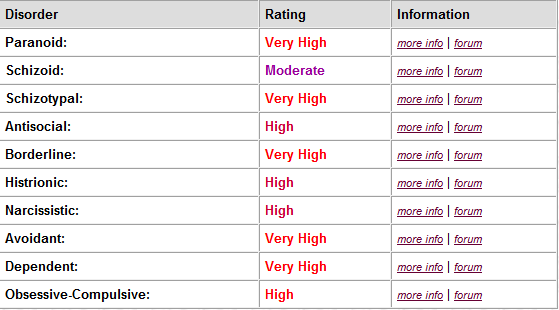 |
2 – LiteTheIronMan, Misty
Moderator
2,066 posts
I just realized that histrionic and schizoid personality disorder are like complete opposites.
|
Originally Posted by Wikipediatrician
Histrionic personality disorder (HPD) is defined by the American Psychiatric Association as a personality disorder characterized by a pattern of excessive emotionality and attention-seeking, including an excessive need for approval and inappropriately seductive behavior, usually beginning in early adulthood. These individuals are lively, dramatic, vivacious, enthusiastic, and flirtatious.
... Schizoid personality disorder (SPD) is a personality disorder characterized by a lack of interest in social relationships, a tendency towards a solitary lifestyle, secretiveness, emotional coldness and sometimes (sexual) apathy, with a simultaneous rich, elaborate and exclusively internal fantasy world. |
2 – LiteTheIronMan, Shadow
Linoone
95 posts
Paranoid: Very High
Schizoid: Low
Schizotypal: Moderate
Antisocial: Low
Borderline: Very High
Histrionic: High
Narcissistic: Moderate
Avoidant: Very High
Dependent: High
Obsessive-Compulsive: Moderate
It's obviously not gonna be super accurate, and I don't know if I answered some of the questions right/truthfully or whatever.. but I dunno.
Haxorus
292 posts
|
Originally Posted by PokeRemixStudio
I just realized that histrionic and schizoid personality disorder are like complete opposites.
Funny how one could ever have both, according to some test results. |
Haxorus
343 posts
|
Originally Posted by Misty
|

Moderator
3,268 posts
Paranoid: Low
Schizoid: Moderate
Schizotypal: High
Antisocial: Low
Borderline: Low
Histrionic: Low
Narcissistic: Moderate
Avoidant: Moderate
Dependant: Low
Obsessive-Compulsive: Low

Servine
55 posts
I got High and Very High on everything but Antisocial; I find this odd because I'm not narcissistic and I hate being the center of attention, so Histrionic Personality Disorder shouldn't be listed. The rest seem fairly true 
Disorder Rating
Paranoid: Very High
Schizoid: High
Schizotypal: High
Antisocial: Moderate
Borderline: Very High
Histrionic: High
Narcissistic: High
Avoidant: Very High
Dependent: Very High
Obsessive-Compulsive: High

Rayquaza
3,934 posts
I took this test for the fun of it and I am not even sure if the results are true:
Disorder / Rating
Paranoid: High
Schizoid: High
Schizotypal: Moderate
Antisocial: Low
Borderline: Low
Histrionic: Low
Narcissistic: Moderate
Avoidant: High
Dependent: Moderate
Obsessive-Compulsive: Moderate

Keldeo
1,136 posts
Disorder | Rating
Paranoid: Low
Schizoid: Low
Schizotypal: Moderate
Antisocial: Low
Borderline: Low
Histrionic: High
Narcissistic: Moderate
Avoidant: Low
Dependent: Low
Obsessive-Compulsive: Moderate
-----
Soooo i'm an attention *****? Noooot to much of a shock.
This pink is drawing your attention right?! Right?!!?

Kyurem
2,014 posts
Disorder | Rating
Paranoid: Low
Schizoid: Moderate
Schizotypal: Moderate
Antisocial: Moderate
Borderline: Low
Histrionic: Moderate
Narcissistic: Moderate
Avoidant: Low
Dependent: Low
Obsessive-Compulsive: Low
I'm surprised I didn't get high on antisocial. I guess I'm pretty normal.

Shaymin
2,710 posts
MY results are pretty good, the recap is...
-I have Schizotypal personality disorder (meaning I am socially awkward and I force myself to believe unconventional things)
-Im independant
-I am Narcissistic, which in a nutshell in self-centeredness
-I have a same case of Histirionic personality disorder, and for people not knowing what it mean... I like to have attention...

Volcarona
496 posts
To prove my obsessive-compulsiveness, I'm gonna organise this into a sexy table.
| Paranoid | Low |
| Schizoid | Low |
| Schizotypal | Moderate |
| Antisocial | Moderate |
| Borderline | Low |
| Histronic | Low |
| Narcissistic | Low |
| Avoidant | Low |
| Obsessive-Compulsive | Very High |

Cyndaquil
21 posts
Bump:
Disorder | Rating
Paranoid: High
Schizoid: Very High
Schizotypal: High
Antisocial: Low
Borderline: Low
Histrionic: Moderate
Narcissistic: Moderate
Avoidant: Moderate
Dependent: Moderate
Obsessive-Compulsive: Low

Keldeo
1,021 posts
| Paranoid | Very High |
| Schizoid | Moderate |
| Schizotypal | Very High |
| Antisocial | High |
| Borderline | Moderate |
| Histrionic | Moderate |
| Narcissistic | High |
| Avoidant | High |
| Dependent | High |
| Obsessive-Compulsive | High |

Volcarona
676 posts
| Paranoid | Moderate |
| Schizoid | High |
| Schizotypal | Very High |
| Antisocial | Low |
| Borderline | Moderate |
| Histrionic | Low |
| Narcissistic | Low |
| Avoidant | High |
| Dependent | High |
| Obsessive-Compulsive | High |

Servine
59 posts
Paranoid: Moderate
Schizoid: Low
Schizotypal: Low
Antisocial: Moderate
Borderline: Low
Histrionic: Moderate
Narcissistic: Low
Avoidant: Low
Dependent: Low
Obsessive-Compulsive: High
Well, okay. I guess that reveals a little bit about me.

Zoroark
237 posts
Paranoid: Low
Schizoid: Low
Schizotypal: Moderate
Antisocial: Low
Borderline: Low
Histrionic: Moderate
Narcissistic: Low
Avoidant: Moderate
Dependent: Low
Obsessive-Compulsive: Low
A LOT better than I was one year ago. :3
